
Everything it does. Nothing it doesn’t.
Every line below describes shipped behaviour in the current Android build. No roadmap items, no “coming soon”.
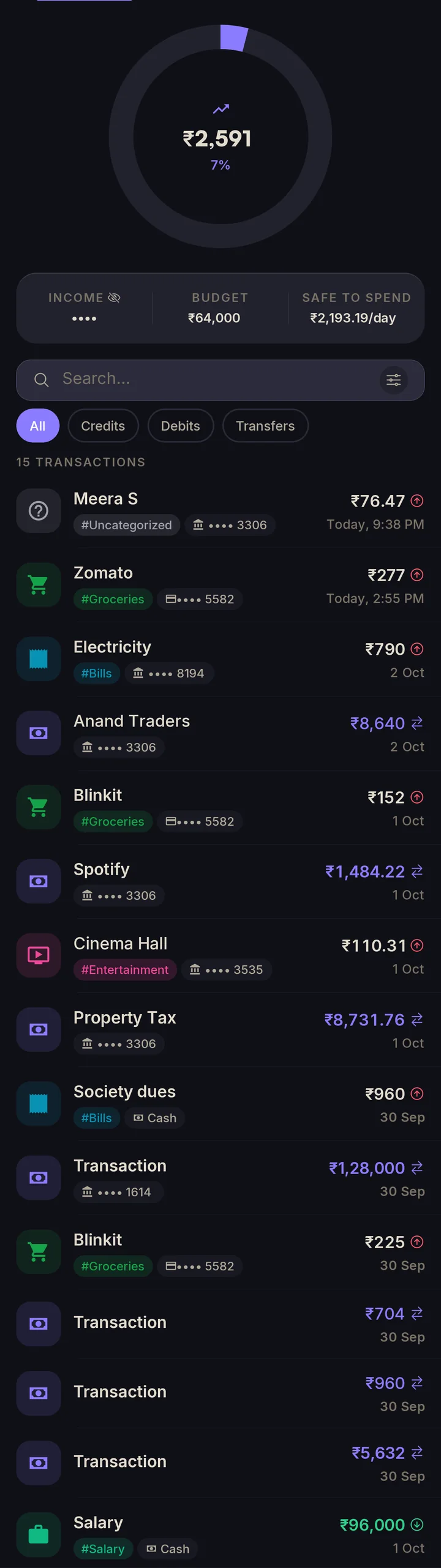
Every bank alert, already a transaction.
The SMS your bank sends is the most reliable record of your money that exists. WealthMonk reads it on the phone and turns it into a ledger — no bank login, no aggregator, no typing.
- 62 banks, by their registered sender IDs. Every scheduled commercial, small-finance and payments bank, the major foreign banks and American Express, recognised from the DLT headers they actually send from — not a guessable bank code.
- Amount, direction, merchant, account. Plus the kind of account (bank, credit card, prepaid), a foreign-currency amount when there is one, and the balance the bank itself stated.
- Credit cards identified from the message. A card is created as a card the first time it is seen — so it is never mistaken for savings, and card spends never inflate your assets.
- Never blocked on an inbox. A high-confidence parse is recorded immediately; a low-confidence one is recorded too and flagged for a quick check. The ledger is never held hostage to review.
- 1,000+ merchants named. Swiggy, Zepto, IRCTC, your electricity board — a dictionary of Indian brands maps the sender’s shorthand to a name and a category. Teach it once and it remembers.
- No duplicates, ever. Each alert is fingerprinted with SHA-256 on the phone and again in the database. Re-syncing, reinstalling or a second device cannot import the same one twice.
- Runs in the background. New alerts are picked up while the app is closed, every 15 minutes, so the numbers are current when you open it.
- Balances anchored to the bank. When an alert quotes your available balance, the account is set to it. No drift from a mis-parsed transaction three months ago.

Bills that show up on their own and settle by the bank’s word.
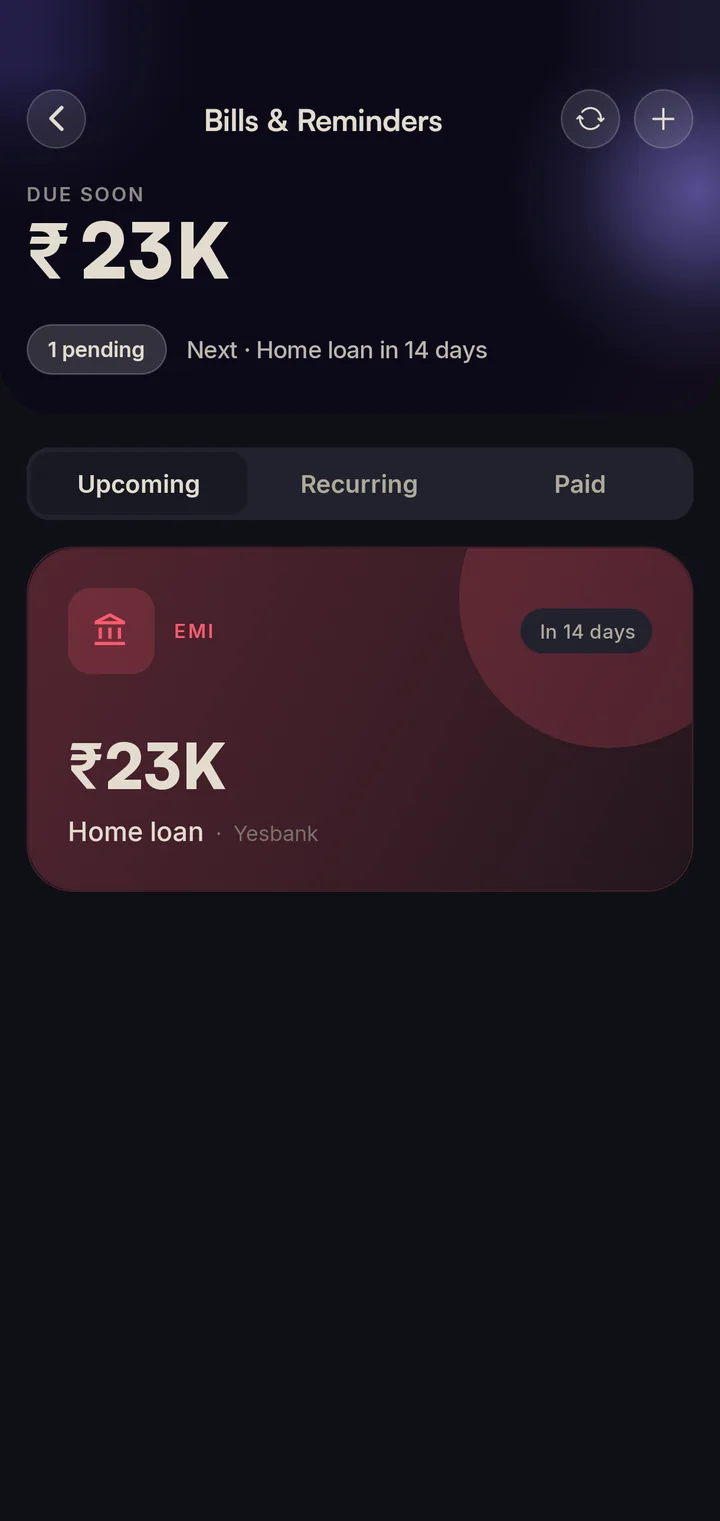
Card statements, EMIs, insurance premiums, utilities and subscriptions — read from SMS, reminded before due, and marked paid by the issuer’s confirmation rather than your memory.
- Statements appear the moment they land. A card statement is in Upcoming as soon as the issuer’s SMS arrives, with the due date the statement quotes — not a guessed cycle.
- Paid means paid, everywhere. Mark a card paid in Bills, on the home card or in Card Health — or let the “payment received” SMS do it — and every screen agrees at once.
- Part payments handled honestly. ₹10,000 of a ₹14,860 statement paid? The bill now shows ₹4,860 still owed — and warns if that is below the minimum due.
- Reminders that actually fire. Three days before and on the due day, scheduled with the OS so they arrive even if the app has not been opened.
- Weekly, monthly, quarterly, half-yearly, annual. Recurring rules for every real cadence, with an append-only payment history behind each.
- Subscriptions suggested, not assumed. A charge that repeats is offered as a subscription with a one-tap “track it” or “not a subscription” — never silently added.
- Offline-first. Bills live in an encrypted local database first. Mark one paid without signal; it syncs when you have it.
- Local dates. A bill due on the 1st is due on the 1st — not the 31st because a server sat in another timezone.
The rupee cost of a card, before you pay it.
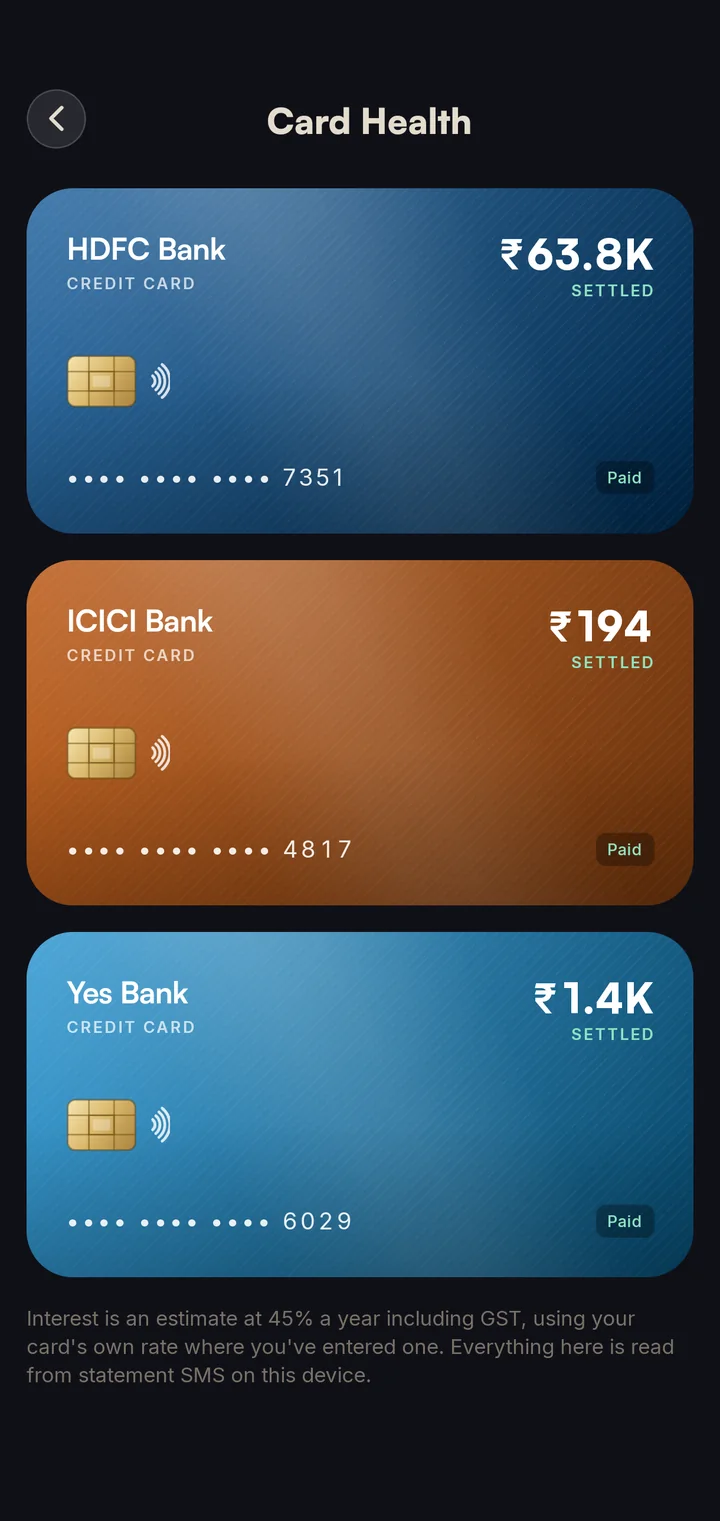
Revolving a credit card balance in India costs 36–48% a year. WealthMonk watches every card it has seen a statement for and says, in rupees, what a decision will cost.
- Total outstanding vs. this statement. Two figures for two questions: what do I owe in total, and what is left of the statement that is due now?
- Minimum due, tracked. Read from the statement SMS and kept — so paying only the minimum is a choice you see, with the interest it invites next to it.
- The wrong-pocket alert. Idle savings sitting in a bank account while a card balance is about to revolve — the single most expensive habit, caught before the due date.
- Shortfall warning. Due within three days and the account it is usually paid from cannot cover it? You hear about it now, not from a late fee.
- Fees and finance charges detected. When an issuer actually levies interest or a late fee, it is recognised from the SMS and shown for what it is.
- Never a false accusation. A card whose payments the app cannot see is never marked unpaid. Silence is not evidence.
One number that means what it says.
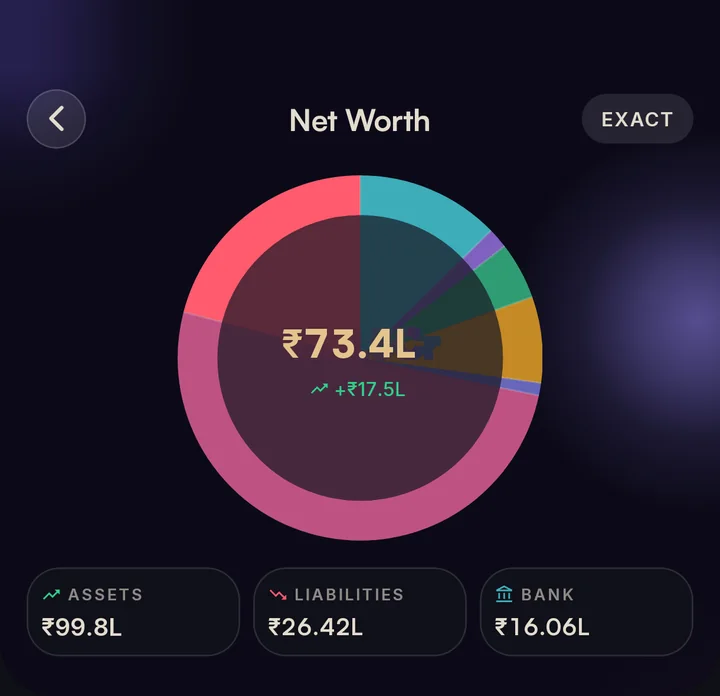
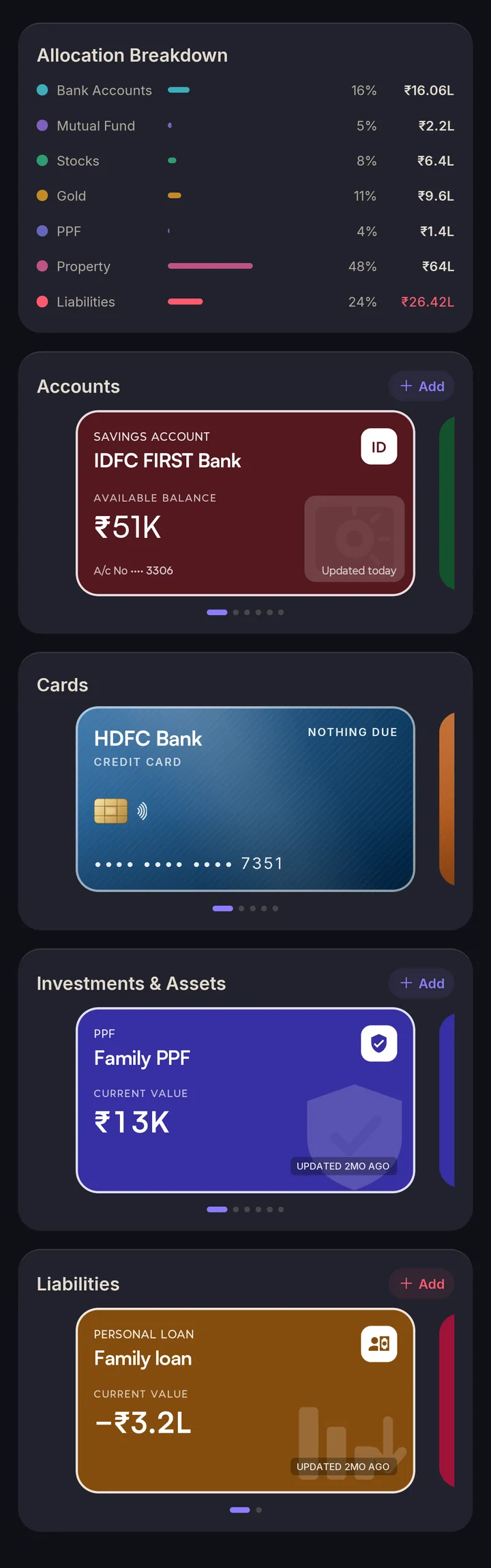
A net worth is only useful if the arithmetic behind it is strict. Cards are liabilities, investments are not expenses, and balances come from the bank.
- Accounts and cards kept apart. A deposit balance is money you have. A card balance is money you owe. They are never added together, whatever the SMS looked like.
- Nine asset classes. Fixed deposits, mutual funds, stocks, gold, PPF, EPF, NPS, property and other — with monthly contributions and whether each counts toward FIRE.
- Investments out of your expenses. A SIP is a transfer to future you, not spending. It leaves the expense total and joins the corpus.
- Loans that know when they end. From the EMI and remaining tenure in your own alerts, every loan shows its end date and the interest still ahead.
- Transactions linked to assets and goals. Link a transfer to a goal or an asset and the balance moves with it — atomically, on the server, not in two racing updates.
- Reorder, compact, passbook. Drag accounts into the order you think in. See ₹1.24Cr or ₹1,24,36,580 — your choice. Open any account as a passbook.
- Export when you want. CSV, spreadsheet and PDF exports of your ledger and calculators, generated on the phone and shared from it.
Goals judged on schedule and on affordability. Separately.
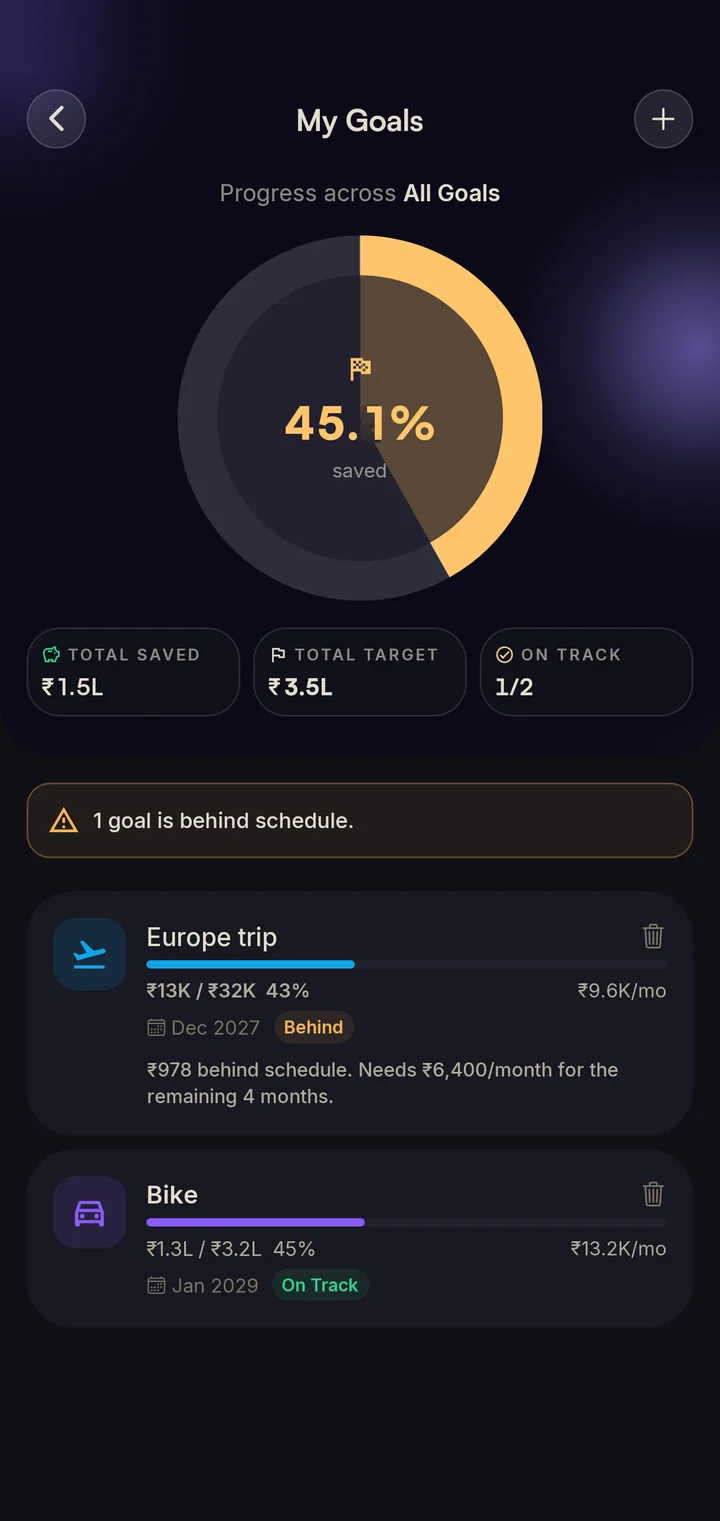
Most goal trackers say “on track” forever. WealthMonk asks two questions — is the balance where it should be by now, and can your real monthly surplus carry it — and tells you when either answer changes.
- Five honest states. On Track · At Risk · Behind · Not Fundable · Overdue. “Not Fundable” is a verdict most apps refuse to give.
- Surplus computed from your ledger. What is left over each month is worked out from your average spend and existing SIPs — not from the income you typed once.
- A portfolio view. The total monthly need across every goal against the surplus that has to fund them.
- Notified when a goal slips. On app open and in the background: a goal that moves from On Track to At Risk tells you, once, with the amount that fixes it.
- Unknown is a state too. No income set? Affordability says “unknown”, not a made-up green tick.
The long game, from the same ledger.
Every planning tool reads the transactions you already have, so the answers are about your life — not a generic calculator with your name on it.
- Financial health score. Spend, save, borrow, protect — four verdicts and one number, recomputed as the ledger changes.
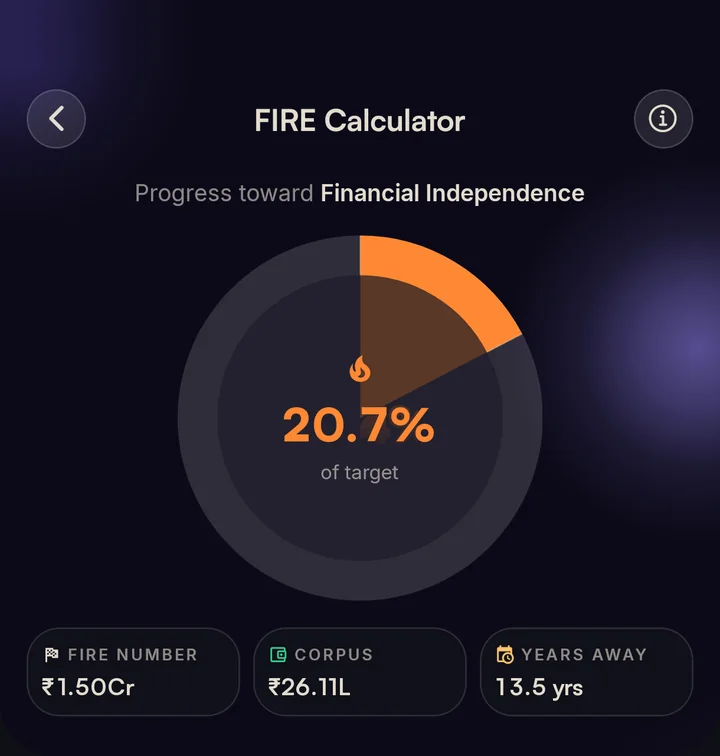
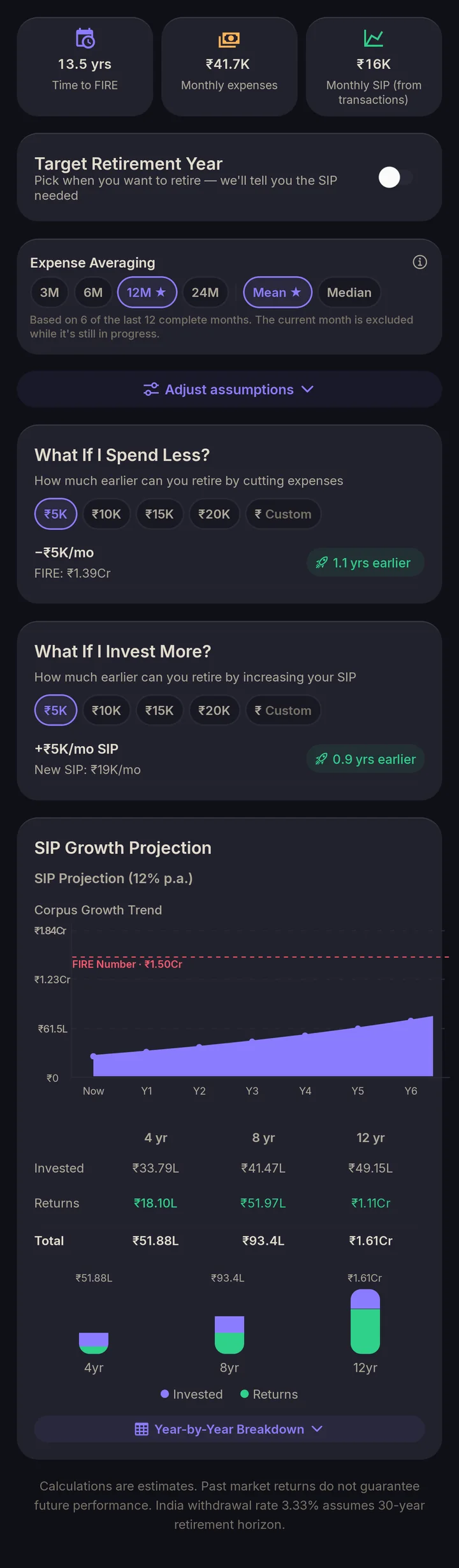
- FIRE calculator. The corpus that funds your expenses, the SIP that gets there by your date, and where you already stand — with your real SIPs and existing investments counted.
- Tax dashboard. What you have actually paid toward 80C, 80D, NPS and the rest this financial year, and the headroom left — planning, not filing.
- Debt manager. Avalanche or snowball across every loan and card, with the interest each order saves and the month you are free.
- Insurance check. Life and health cover adequacy from your income, dependants and liabilities. WealthMonk sells no policy, so the number has no agenda.
- Financial calculators. SIP (with step-up), SWP, EMI, RD, FD, inflation, simple and compound interest — each exportable as a PDF or spreadsheet.
- Insights with a decision attached. Every insight names the one thing it is asking you to decide, and arrives once — not as a daily nag.
The small things, done properly.
The parts you touch every day are built with the same care as the parser.
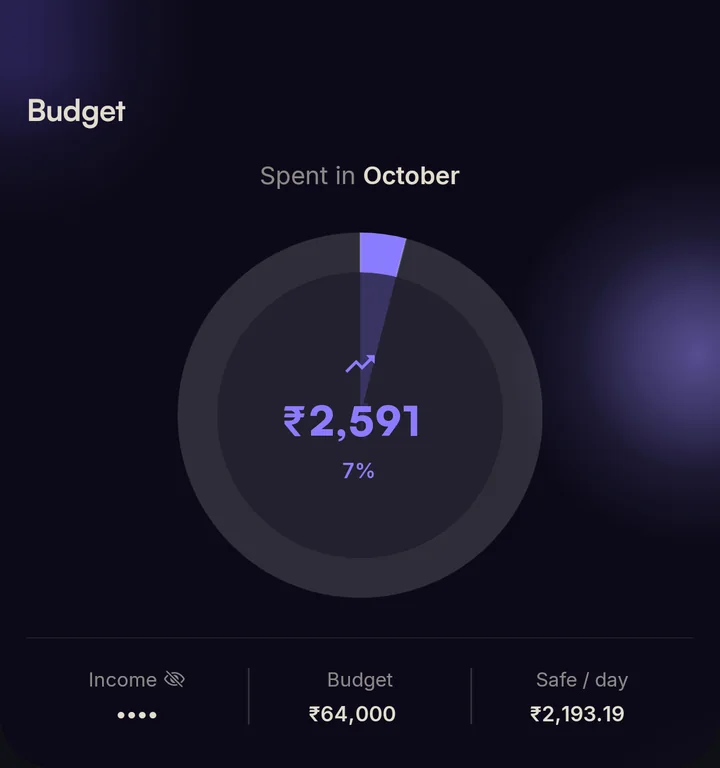
- Safe to spend per day. (Budget − spent) ÷ days left. The one number that answers “can I?”, updated with every alert.
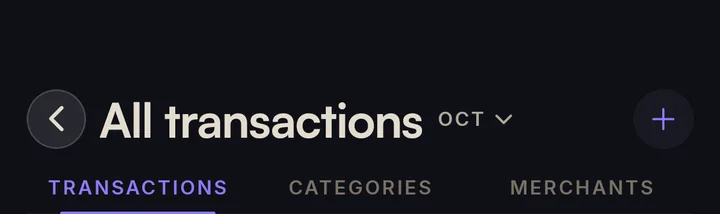
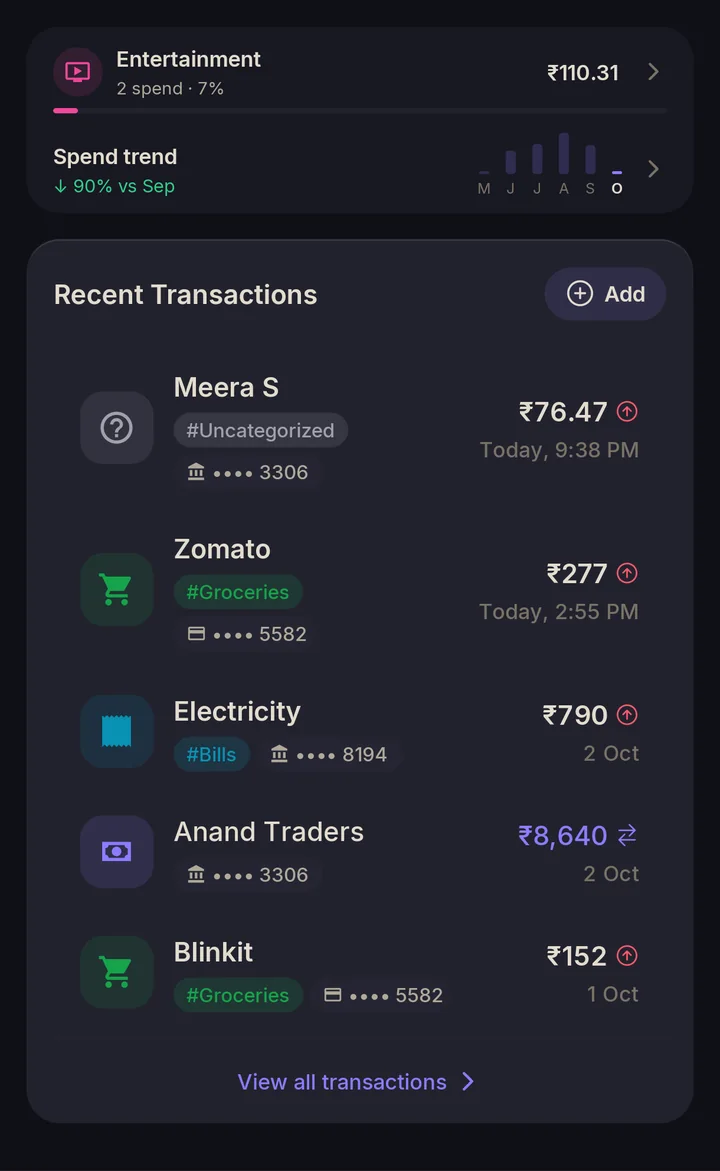
- Real filters. Accounts, cards, categories, amount and date ranges, credits/debits/transfers — with a filtered total.
- Manual entry that is quick. Amount, payee with autocomplete, account, category, note, receipt photo, recurring flag. Transfers between your own accounts.
- Undo. Swipe to delete, then change your mind. Deleted SMS imports stay deleted on the next sync.
- Notification centre. Every alert lands in the bell, whether or not the OS showed it. Tap one and land on the screen it was about.
- Biometric lock. Fingerprint or face when you return, and screenshots blocked on every financial screen.
- Dark and light, edge to edge. Obsidian and Gallery themes, and a layout that scales from a 360dp phone to a large one without a single wrapped amount.

Your money, finally in one honest picture.
Free on Android. Reads your bank SMS on the device, never uploads them, and never sells you a product.